
SAT Reading and Writing – domains and prep
The four domains of the Digital SAT Reading and Writing section, the question types, and an effective study approach.
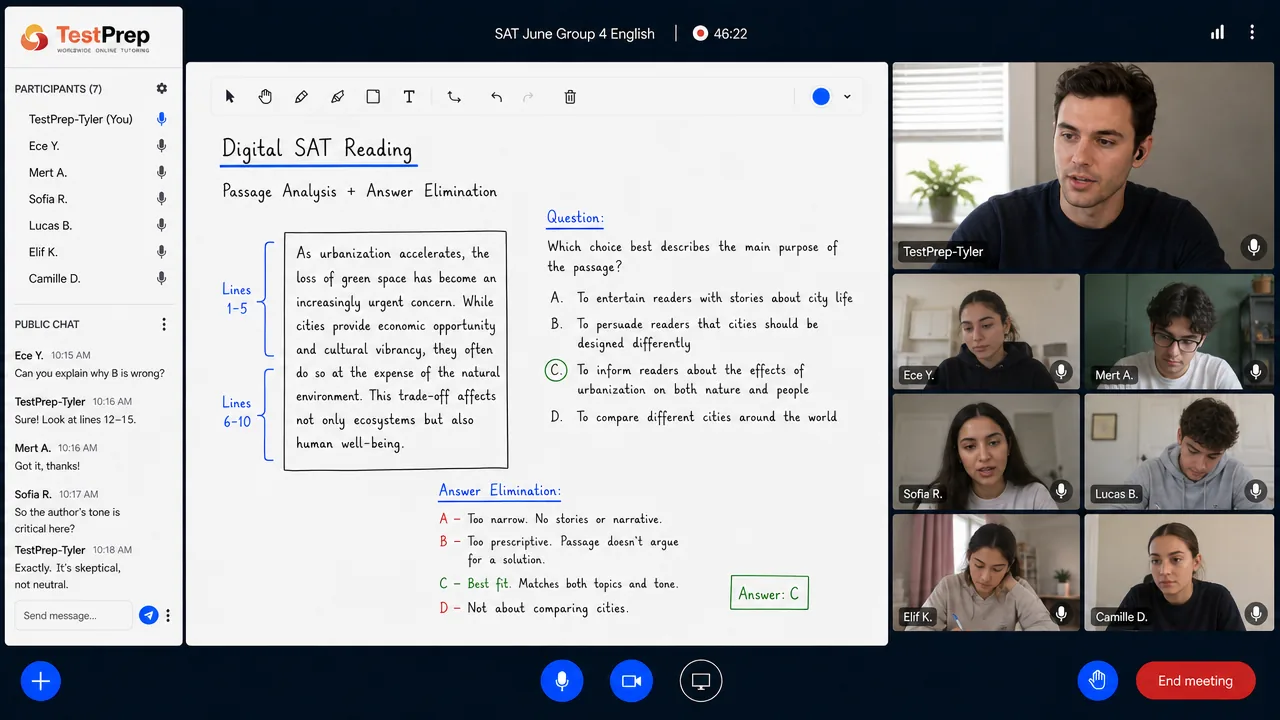
Quick answer: what is SAT R&W?
The Digital SAT Reading and Writing section has two modules (27 questions × 32 minutes each). Questions sit around short passages and Module 2 difficulty is adaptive based on Module 1. The section is scored 200-800.
Is it timing, vocabulary, grammar, or inference?
After a Bluebook-format full R&W test, we review right/wrong distribution by Words in Context, Transitions, Evidence (textual & quantitative), Rhetorical Synthesis and Standard English Conventions.
- Grammar conventions: rule gaps or carelessness?
- Words in Context: vocabulary range
- Evidence questions: which option can't you eliminate?
- Rhetorical Synthesis: matching the stated purpose
- Per-module time pressure and the last 6 questions
- Wrong-answer analysis and weekly platform homework
First measure your level, then we'll build the plan.
Take a practice testContact formMessage on WhatsAppWhat each of the four R&W domains tests
Reading short texts and answering questions about main ideas, supporting details, and the relationship between text and graphic data.
- Central ideas and details
- Inferences
- Command of evidence (textual)
- Command of evidence (quantitative)
How language and structure shape meaning. Words in context, the function of a sentence, and connections between paired texts.
- Words in context
- Text structure and purpose
- Cross-text connections
Choosing the most effective sentence to fulfil a given rhetorical goal. Transitions and rhetorical synthesis questions live here.
- Transitions
- Rhetorical synthesis
Grammar, punctuation and sentence structure. The most pattern-driven domain — fast progress is possible with focused study.
- Subject-verb agreement
- Pronouns and modifiers
- Sentence boundaries
- Punctuation (commas, semicolons, colons)
The most common R&W mistakes
- Skimming the prompt and answering a different question than asked.
- Choosing the 'true' answer instead of the answer best supported by the text.
- On Transitions: choosing a logically related word instead of the relationship the text actually establishes.
- On Rhetorical Synthesis: ignoring the stated rhetorical purpose.
- On Conventions: relying on what 'sounds right' instead of testing the rule.
- Spending too long on a single hard question and losing easy points later.
- Not flagging questions to revisit before submitting the module.
About SAT Reading & Writing
Which topics appear in SAT Reading and Writing?
R&W has four domains: Information and Ideas, Craft and Structure, Expression of Ideas, and Standard English Conventions.
How many questions and minutes in R&W?
R&W has two modules. Each module has 27 questions in 32 minutes. Module 2's difficulty is adaptive based on Module 1 performance.
What kind of questions?
Every question uses a short passage or text snippet. Instead of the old long-passage format, each question carries its own mini context; all are multiple choice.
What is critical for top R&W scores?
Maintaining high accuracy on Words in Context, Transitions and Standard English Conventions, and choosing the answer that fits the stated rhetorical purpose in Rhetorical Synthesis questions.
Let's build your path to your target SAT score
Share your current level, target score and test date — we'll send back a package recommendation and a week-by-week plan built from those three. No purchase required.